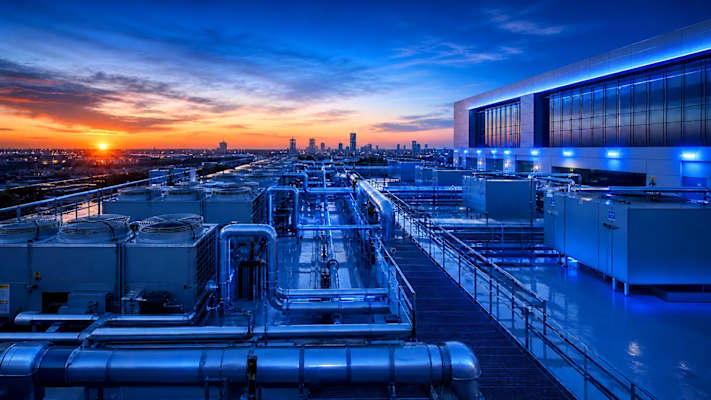
Cooling Innovations: Exploring Water-Cooled Chillers for Commercial Excellence
India's commercial construction pipeline isn't slowing down. New hospitals, data centres, mixed-use towers, and logistics hubs are coming up faster than ever, and behind every one of them is an HVAC decision that will define operating costs for the next two decades. Water-cooled chillers sit right at the centre of that decision for most large-scale projects.
The reason they dominate at large scale infrastructure is pretty straight forward, the water carries heat away more effectively than air does. That's not a marketing claim, it's physics. And in a country where summers are punishing, and energy bills are scrutinised, that thermal efficiency advantage compounds quickly.
Screw vs Centrifugal Picking the Right Machine
Not all water-cooled chillers work the same way, and the distinction matters more than most specification sheets let on.
With screw compressors, variable load capability is part of the deal. The cooling requirements at 11 am in a mall located in Pune are very different from the cooling requirements at 9 pm. A hotel's chiller plant works hard during a conference and idles during off-season. Screw chillers manage those swings without burning excess energy during low-load periods, which, across a full year, is where most of the running hours actually sit.
Centrifugal compressors have a completely different nature, and they’re designed to run at a constant high load capacity. This is the kind of load you see in large office campuses, airports, or integrated townships where the plant rarely gets a break. At that scale, their dynamic compression design delivers efficiency numbers that are genuinely difficult to match with any other technology.
The decision between the two isn't about brand preference or price alone. It comes down to an honest look at peak load, how much time the system spends at part load, available plant room space, and what the lifecycle cost picture actually looks like over 20 years. Get that analysis right, and the technology choice usually becomes obvious.
Why VFD Compressors Change the Economics
Variable Frequency Drive (VFD) compressors have done more for chiller efficiency in the last decade than almost any other single development. The concept is simple: instead of running at a fixed speed regardless of demand, the compressor modulates to match what the building actually needs at that moment.
In Indian conditions, this is a factor that matters enormously. Monsoon months in Mumbai or Chennai reduce cooling loads considerably. A chiller running VFD technology during those months isn't burning energy it doesn't need to. Over a full operating year, that can translate to 30–40% lower energy consumption compared to fixed-speed alternatives.
There's a secondary benefit that often goes underappreciated: reduced mechanical stress. A compressor that isn't hammering away at full speed during every start-up cycle lasts longer and requires less unplanned maintenance for a hospital or data centre where downtime simply isn't an option, which matters as much as the energy savings.
Efficiency Standards More Than a Compliance Exercise
ASHRAE 90.1 (the American Society of Heating, Refrigerating, and Air-Conditioning Engineers' energy standard for buildings) gets referenced a lot in chiller specifications, often without much thought. But the numbers it sets around Coefficient of Performance (COP) and Integrated Part Load Value (IPLV) are genuinely useful benchmarks for comparing machines on a level playing field.
In India, BEE star ratings and the Energy Conservation Building Code (ECBC) have established a minimum standard for commercial building projects. For commercial buildings aiming for LEED or IGBC accreditation, the cooling capacity has to pass certain benchmarks rather than simply meeting claims by the manufacturers.
This means that conforming to these requirements is not only necessary for compliance but will also impact the energy consumption cost, the results of the green building certification process, and the market value of the property itself.
What Local Manufacturing Actually Means in Practice
There's a tendency to treat Make in India as a political talking point rather than an operational consideration. For HVAC projects, it's very much the latter.
The lead time for imported equipment may lengthen the project duration to an undesirable extent, while delays cost a lot in India. Local manufacture of chiller systems shortens the time frame required. However, the main difference comes not from lead time but rather from how the equipment behaves in Indian environmental conditions.
Ambient temperatures in Rajasthan or interior Maharashtra regularly push past what many imported systems were originally rated for. Power quality in industrial corridors isn't always what a spec sheet assumes. Chillers developed with these variables built in, not accommodated as an afterthought, simply hold up better over time.
For facility managers, that translates to faster commissioning, a service network that can actually reach the site, and spares availability that doesn't require a three-month import cycle.
Getting the Decision Right
A chiller selection made purely at upfront cost is rarely the right one. The machine that wins the tender doesn't always win the lifecycle cost comparison five years in.
What separates good decisions from expensive ones is the quality of the analysis: energy modelling that reflects how the building will actually operate, not just at theoretical peak load; lifecycle cost projections that account for realistic energy tariffs and maintenance patterns; and a clear-eyed view of which efficiency standards the project genuinely needs to meet.
If you're specifying or procuring cooling infrastructure for a commercial project and want to work through the technical and commercial variables in detail, Carrier India's engineering team is available for that conversation. Visit carrier.com/commercial/en/in to explore the portfolio or get in touch directly.